Category: Author


Working Paper: Knowledge in Peacebuilding: Elements, Production, Dissemination

Working Paper: Knowledge in Peacebuilding: Elements, Production, Dissemination

edited by Marie-Christine Heinze and Bilkis Zabara

This publication is the result of a summer school entitled “Academic Approaches to Peacebuilding in Yemen” held in Amman, Jordan, in September 2016, which brought together advanced academics from the University of Bonn and the Gender-Development Research & Studies Center at Sanaa University as well as MA and PhD students from Yemen and Germany. In an exercise over the course of two mornings, the student participants, led by the editors of this paper, developed recommendations for researchers and policy-makers on how best to approach, implement and present research on peacebuilding in societies in conflict. The exercise aimed to achieve two objectives: a) to develop a guide for young researchers, NGOs and policy-makers involved in generating knowledge on and for peace-building processes; and b) to subject the summer school participants to a intercultural / inter-academic writing and learning process in which a German and a Yemeni student teamed up to produce one recommendation. This paper is the result of this exercise.

Download in English or Arabic.

Bilkis Zabara, Marie-Christine Heinze, Other, Peacebuilding and State building in Yemen, Publications
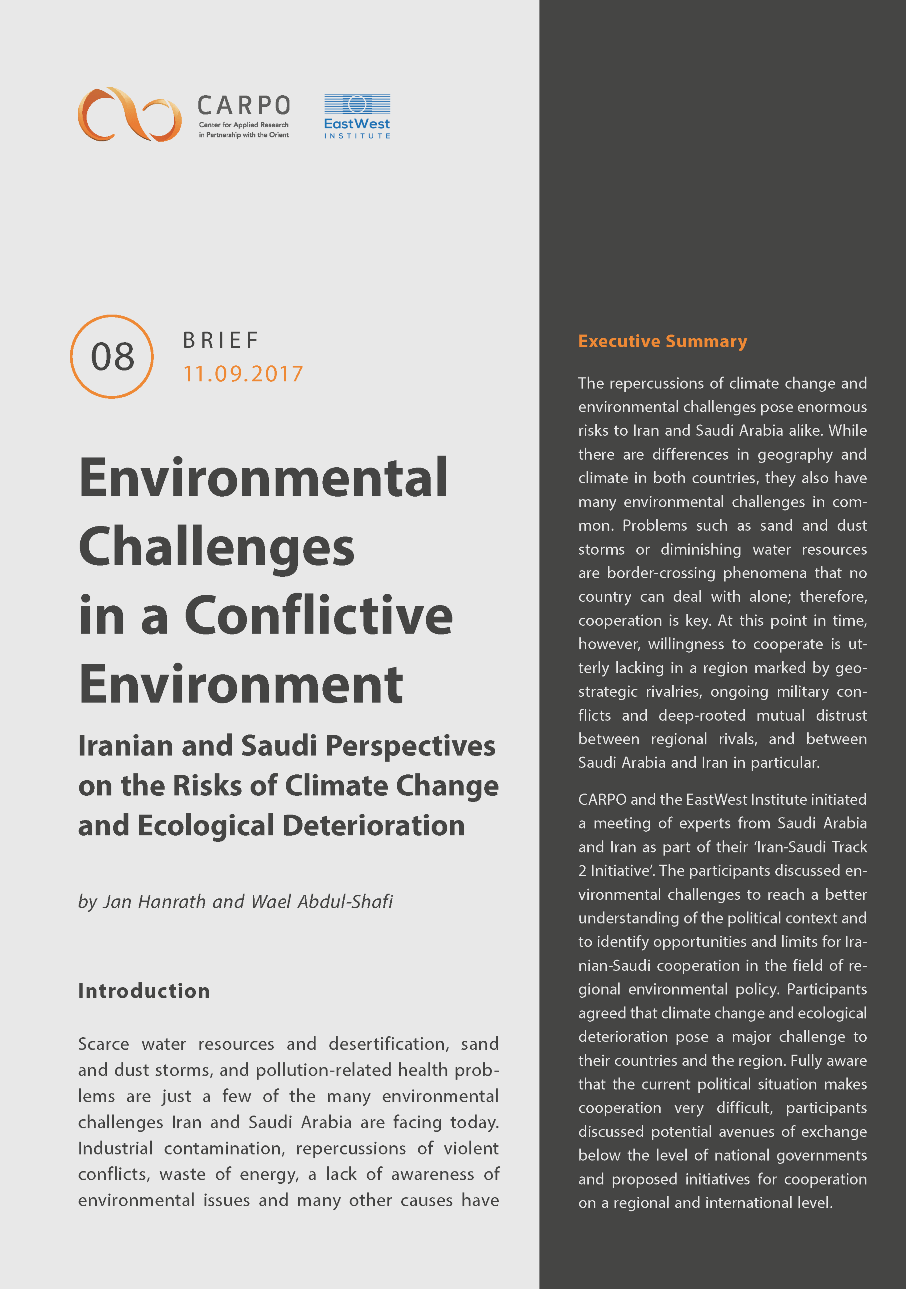
Environmental Challenges in a Conflictive Environment. Iranian and Saudi Perspectives on the Risks of Climate Change and Ecological Deterioration.

Environmental Challenges in a Conflictive Environment. Iranian and Saudi Perspectives on the Risks of Climate Change and Ecological Deterioration.

by Jan Hanrath und Wael Abdul-Shafi

The fourth meeting of CARPO and the EastWest Institute’s ‘Iran-Saudi Track 2 Initiative’ dealt with the political, social and economic risks posed by current environmental challenges to Iran and Saudi Arabia alike. The workshop brought together academics, environmental experts, security analysts and former diplomats from Iran and Saudi Arabia as well as international experts. The participants discussed environmental issues to reach a better understanding of the political context and to identify opportunities and limits for Iranian-Saudi cooperation in the field of regional environmental policy. Fully aware that the current political situation makes cooperation very difficult, participants discussed potential avenues of exchange below the level of national governments and proposed initiatives for cooperation on a regional and international level. CARPO/EWI Brief 08 summarizes key insights and recommendations derived from the conference discussions.

view CARPO/EWI Brief
view printer-friendly version

CARPO Briefs, Iran-Saudi-Dialogue, Jan Hanrath, Projects, Publications, Wael Abdul-Shafi
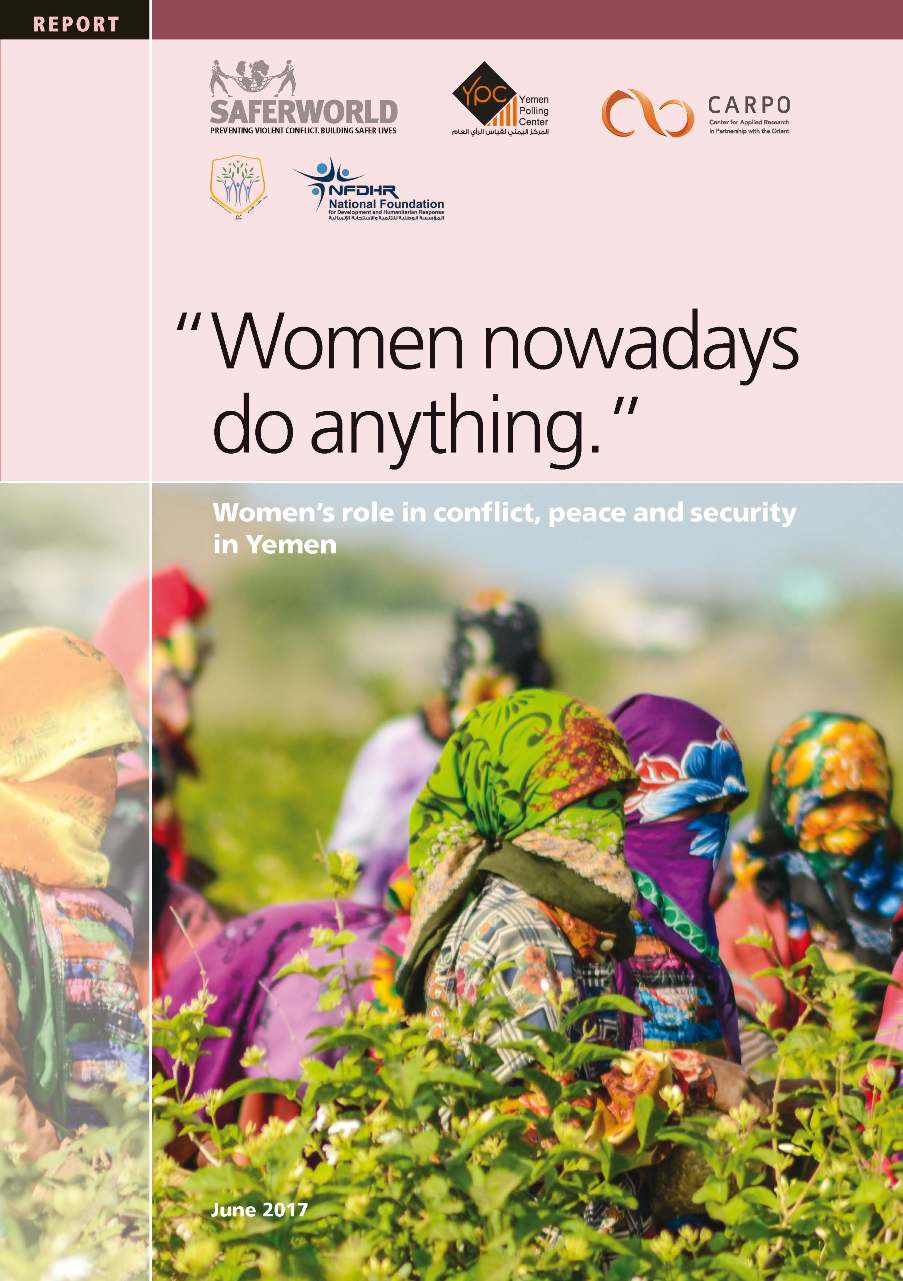
“Women Nowadays Do Anything.” Women’s Role in Conflict, Peace and Security in Yemen

“Women Nowadays Do Anything.” Women’s Role in Conflict, Peace and Security in Yemen

by Marie-Christine Heinze and Marwa Baabbad

This Study brings together the findings of qualitative research conducted in Ibb and Aden by the Yemen Polling Center (YPC) in cooperation with CARPO and Saferworld. It looks at the impact of the war on women and their families in these two regions, particularly in terms of security-related issues, and the roles women play or have played in the conflict as well as in the building of security and peace.

Download

Enhancing Women's Role in Peace and Security, Marie-Christine Heinze, Marwa Baabbad, Other, Publications
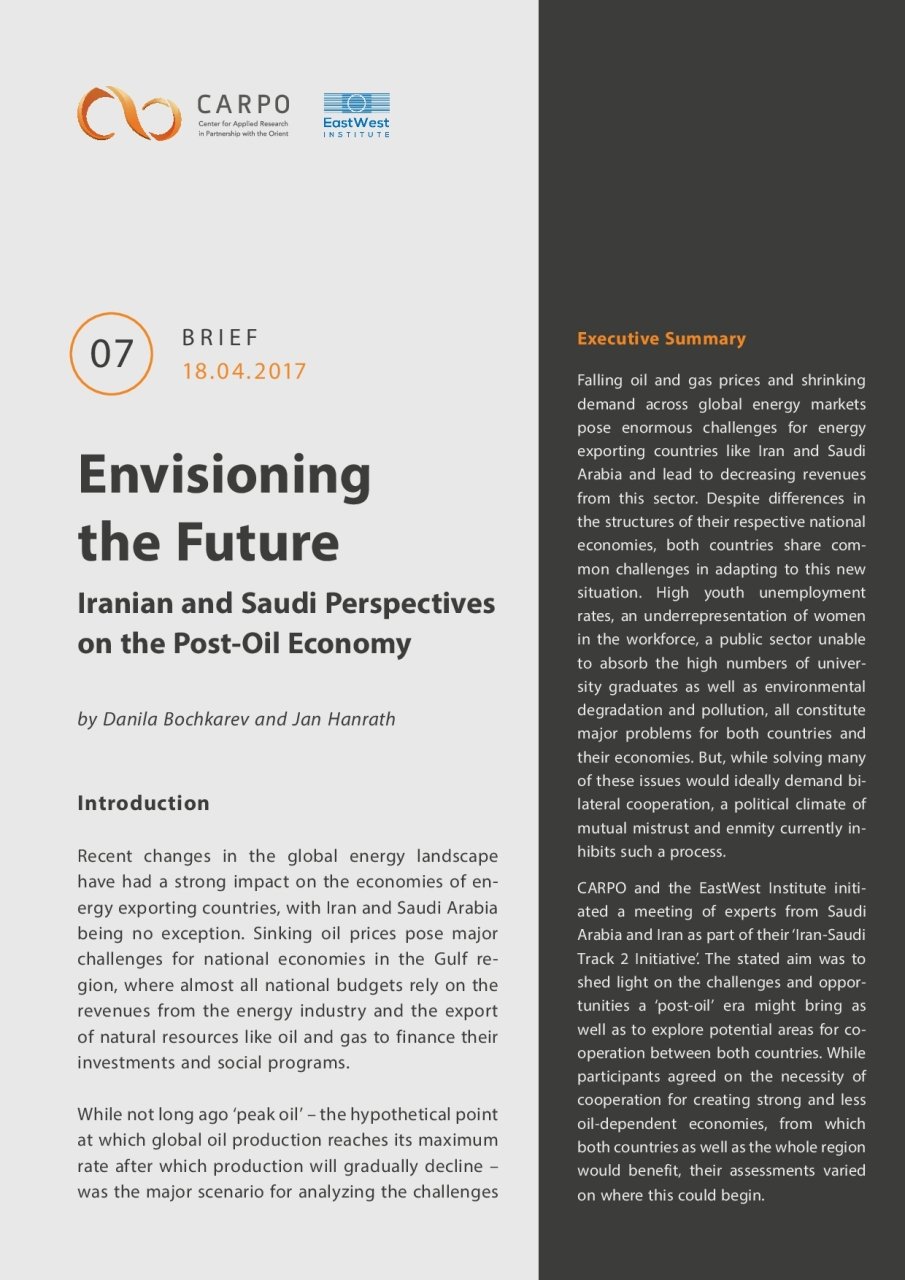
Envisioning the Future: Iranian and Saudi Perspectives on the Post-Oil Economy

Envisioning the Future: Iranian and Saudi Perspectives on the Post-Oil Economy

by Danila Bochkarev and Jan Hanrath

The third meeting of CARPO and the EastWest Institute’s Iran-Saudi Track 2 Dialogue Initiative was dedicated to the repercussions of changing global energy markets on Iran and Saudi Arabia. The workshop brought together policy experts and economists from Iran and Saudi Arabia as well as experts from Europe. They discussed challenges and opportunities a ‘post-oil’ era might bring and explored potential areas for cooperation between both countries. While participants agreed on the necessity of cooperation for creating strong and less oil-dependent economies, from which both countries as well as the whole region would benefit, their assessments varied on where this could begin. CARPO/EWI Brief 07 summarizes key insights and recommendations derived from the conference discussions.

view CARPO/EWI Brief
view printer-friendly version

CARPO Briefs, Danila Bochkarev, Iran-Saudi-Dialogue, Jan Hanrath, Projects, Publications
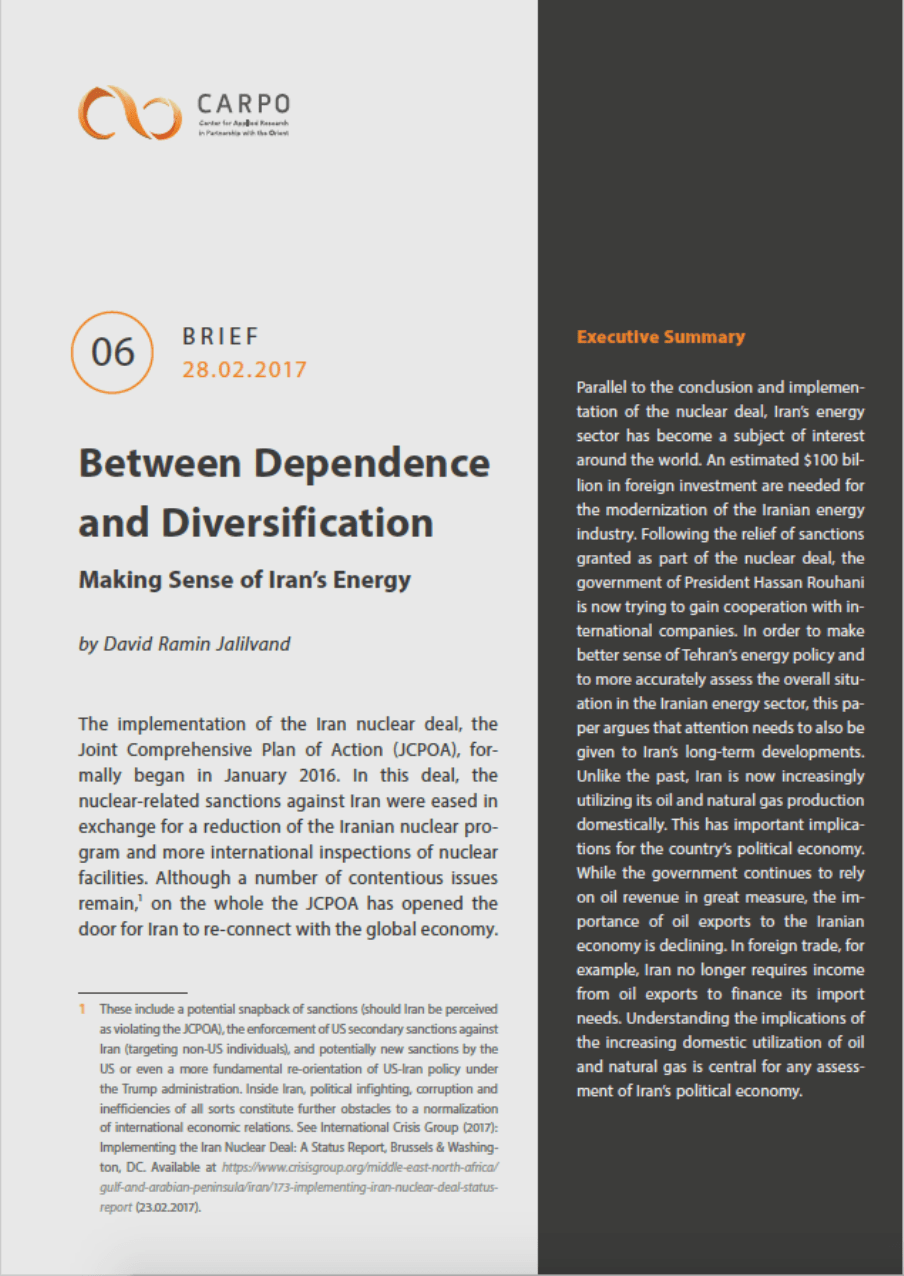
Between Dependence and Diversification. Making Sense of Iran’s Energy

Between Dependence and Diversification. Making Sense of Iran’s Energy

by David Ramin Jalilvand

Parallel to the conclusion and implementation of the nuclear deal, Iran’s energy sector has become a subject of interest around the world. An estimated $100 billion in foreign investment are needed for the modernization of the Iranian energy industry. Following the relief of sanctions granted as part of the nuclear deal, the government of President Hassan Rouhani is now trying to gain cooperation with international companies. In order to make better sense of Tehran’s energy policy and to more accurately assess the overall situation in the Iranian energy sector, this paper argues that attention needs to also be given to Iran’s long-term developments. Unlike the past, Iran is now increasingly utilizing its oil and natural gas production domestically. This has important implications for the country’s political economy.

view CARPO Brief
view printer-friendly version

CARPO Briefs, David Ramin Jalilvand, Publications
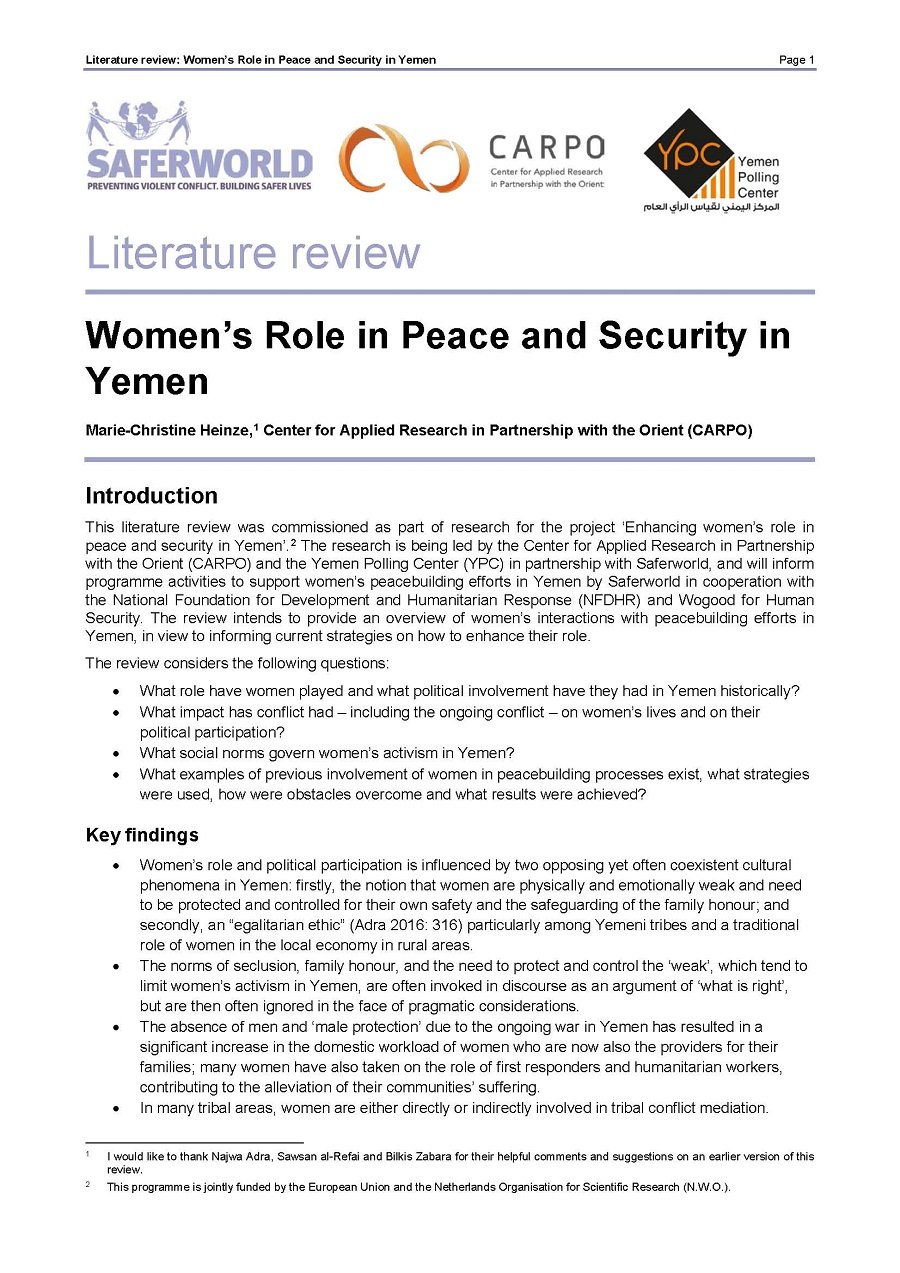
Women’s Role in Peace and Security in Yemen. Literature Review

Women’s Role in Peace and Security in Yemen. Literature Review

by Marie-Christine Heinze

This literature review provides an overview of women’s interactions with peacebuilding efforts in Yemen, in view to informing current strategies on how to enhance their role. In doing so, it considers questions in regard to women’s political participation in the past; the impact of conflict on women’s lives; the social norms governing women’s activism; and examples of women’s involvement in peacebuilding processes.

Download

Enhancing Women's Role in Peace and Security, Marie-Christine Heinze, Other, Publications
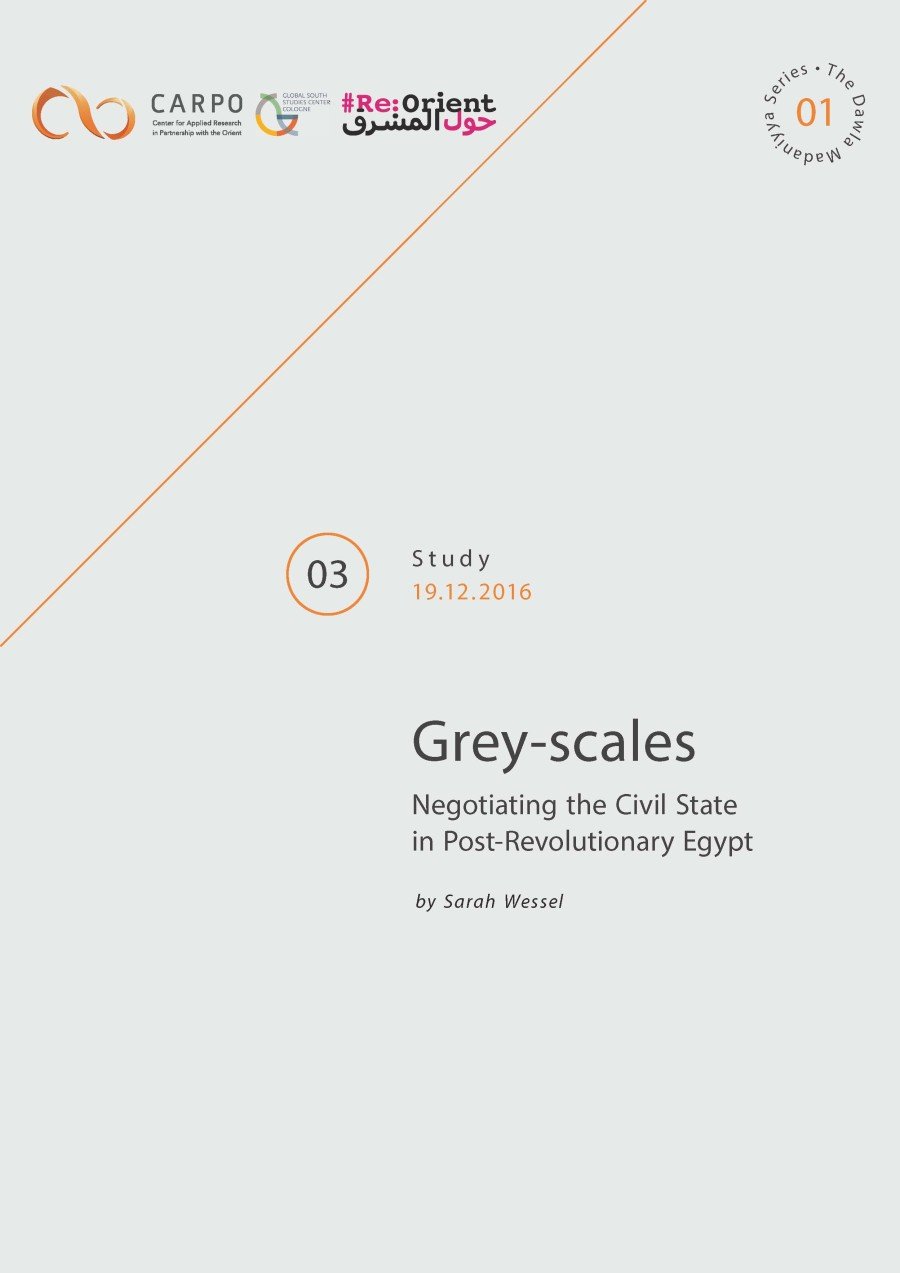
Grey-scales. Negotiating the Civil State in Post-Revolutionary Egypt

Grey-scales. Negotiating the Civil State in Post-Revolutionary Egypt

by Sarah Wessel

As a slogan, dawla madaniyya (civil state) was one of the most often heard during the 2011 ‘Arab Spring’ uprisings across the Arab World. In this CARPO Study, Sarah Wessel explores the changing state-society relations in Egypt, following the so-called 25 January Revolution until the ousting of Muhammad Mursi. By investigating the complex assumptions, perceptions and circumstances expressed in support of the civil state, the authors shows that the diverse notions indicate a deeper shared concern: whether the emerging political and social extremes can be reunified in order to rehabilitate the disintegration of the national collective.

view CARPO/Re:Orient Study
view printer-friendly version

CARPO Studies, Completed Projects, Dawla Madaniyya, Publications, Sarah Wessel
Victimized by Geopolitics. Iranian and Saudi Perspectives on the Refugee Crisis

Victimized by Geopolitics. Iranian and Saudi Perspectives on the Refugee Crisis

by Wael Abdul-Shafi, Kawa Hassan und Adnan Tabatabai

The second meeting of CARPO and the EastWest Institute’s Iran-Saudi Track 2 Dialogue initiative took place in spring 2016 in Bonn. Current and former diplomats, analysts and security experts from both countries met alongside European scholars and experts to discuss “Iranian and Saudi Perspectives on the Refugee Crisis”. During the two-day conference, the participants elaborated on how the term “refugee“ is conceptualized in Saudi Arabia and Iran. They further shared their views and future visions about the ongoing conflicts and the humanitarian crises in Syria, Iraq, Yemen and Afghanistan – the four main ’departure contexts’ of refugees in West and Central Asia. CARPO Brief 05 summarizes key insights and recommendations derived from the conference discussions.

view CARPO/EWI Brief
view printer-friendly version

Adnan Tabatabai, CARPO Briefs, Iran-Saudi-Dialogue, Kawa Hassan, Projects, Publications, Wael Abdul-Shafi
Returning to Transitional Justice in Yemen. A Backgrounder on the Commission on the Forcibly Retired in the Southern Governorates

Returning to Transitional Justice in Yemen. A Backgrounder on the Commission on the Forcibly Retired in the Southern Governorates

by Jens Kambeck

This CARPO Report focuses on the work of the Commission on the Forcibly Retired in the Southern Governorates, which was established in the framework of the GCC Initiative. The author argues that if the unity of Yemen is to be preserved, the only path forward is to take concrete and earnest steps to rebuild trust between North and South through transitional justice, once the ongoing war has come to an end. Such a trust-building process can—amongst others—build on the work of the Commission presented here. The CARPO Report thus concludes with respective recommendations.

view CARPO/IOA/GDRSC Report
view printer-friendly version

CARPO Reports, Jens Kambeck, Peacebuilding and State building in Yemen, Projects, Publications
The EU’s Balancing Act in the Middle East. How to Engage Iran without Alienating GCC States

The EU’s Balancing Act in the Middle East. How to Engage Iran without Alienating GCC States

by Jan Hanrath

Initial hopes that the nuclear agreement between Iran and the E3+3 would increase regional security and decrease political tensions have been dashed. Conflicts in the Middle East are escalating further, and tensions between GCC states and Iran are intensifying. In light of this regional tug-of-war, the EU needs to develop a policy that succeeds in integrating the Iranian position into regional affairs without alienating other allies in the region. Against this backdrop CARPO organized a conference on EU-Middle East relations early this year. CARPO Brief 04 summarizes the conference discussions and outlines potential EU-Middle East initiatives.

view CARPO Brief
view printer-friendly version

CARPO Briefs, Jan Hanrath, Publications
Aden 1986 – The Forgotten Evacuation [in German]

Aden 1986 – The Forgotten Evacuation [in German]

by Hans Jürgen Wendler

In the final phase of the Cold War, as Moscow is losing its grip on the world-wide socialist community of states, a civil war in socialist southern Yemen forces thousands of foreigners to flee to the beaches of Aden. They are brought to safety in a joint rescue mission across Cold War frontiers, including ships from East and West. For the first time in the history of sea evacuations since 1945, a German freighter – the MS “Müggelsee” – is part of the mission. Despite the positive role the GDR played in the rescue mission, it subsequently increases the control of its merchant marine. Thirty years later, contemporary witnesses share their memories and the foreign ministries of both Germanies open their archives. Available only in German.

view CARPO Study
view printer-friendly version

CARPO Studies, Hans Jürgen Wendler, Publications
The GDR, Honecker and the South Yemen Crisis of 1986 [in German]

The GDR, Honecker and the South Yemen Crisis of 1986 [in German]

by Miriam Müller

In January 1986, a internal conflict in the Yemeni Socialist Party (YSP) escalates into a bloody civil war. After a few days, Aden lies in ruins and with it the international credibility of a significantly decimated YSP – a fact that soon took a heavy toll on the erstwhile close relations with the German Democratic Republic (GDR) and its governing party, the Marxist-Leninist Socialist Unity Party. This CARPO Study provides an overview of this special friendship between the GDR and the People’s Democratic Republic of Yemen (PDRY) and analyses the consequences of the 1986 conflict in the context of the last phase of the Cold War. It concluded with a view towards a possible trajectory the GDR-PDRY relationship could have taken had not both states dissolved. Only available in German.

view CARPO Study
view printer-friendly version

CARPO Studies, Miriam Müller, Publications
Know Your Enemy – Iranian and Saudi Perspectives on ISIL

Know Your Enemy – Iranian and Saudi Perspectives on ISIL

by Adnan Tabatabai und Kawa Hassan

CARPO and the EastWest Institute have established a confidential track 2 format for Iranian-Saudi dialogue. The first dialogue meeting took place In the fall of 2015 in Brussels. Current and former diplomats, analysts and security experts from both countries met alongside European policy-makers and experts to discuss “Iranian and Saudi Perspectives on ISIL”. During the 2-day conference, root-causes of the rise of ISIL were outlined along four key dimensions, and comprehensive strategies against violent extremist organizations such as ISIL proposed. CARPO Brief 03 summarizes the most important insights and presents tangible policy recommendations.

view CARPO/EWI Brief
view printer-friendly version

Adnan Tabatabai, CARPO Briefs, Iran-Saudi-Dialogue, Kawa Hassan, Publications
Iran Votes. A Primer to the Elections of Parliament and the Assembly of Experts

Iran Votes. A Primer to the Elections of Parliament and the Assembly of Experts

by Adnan Tabatabai

The twin elections of 26 February 2016 are the first to be held after the nuclear agreement between Iran and P5+1 has been signed. This CARPO Report sheds light on the current political climate in Iran and presents analytical criteria to apprehend both the interplay between parliament and government, as well as the key tasks for the Assembly of Experts. The main electoral contenders and parties are then introduced before the author provides insights on how senior officials view these dual elections. It concludes by highlighting the electorate’s key demands and by presenting a set of parameters to look into the upcoming months.

view CARPO Report
view printer-friendly version

Adnan Tabatabai, CARPO Reports, Publications
Turkey’s Parliamentary Elections and the Quest for Stability

Turkey’s Parliamentary Elections and the Quest for Stability

by Şafak Baş

Turkey is set to hold its parliamentary elections on November 1 in an atmosphere marked by political violence, polarization and insecurity. Regardless of the election outcome, Ankara will need to focus on national reconciliation and the reduction of sociopolitical tensions. Peace talks with the Kurdish PKK must resume. Even as its Western partners should substantially support Turkey in handling the influx of refugees into Turkey and Europe, the West must also urge Ankara to foster national reconciliation and to respect the democratic principles that are deeply rooted in the history of the republic.

view CARPO Brief
view printer-friendly version

CARPO Briefs, Publications, Şafak Baş
Making Sense of Iran’s Iraq Policy

Making Sense of Iran’s Iraq Policy

by Mohammad Ali Shabani

Iran’s relationship with Iraq has come into the limelight amid the onslaught of the Islamic State in Iraq and the Levant (ISIL). Iranian policy is geared towards maintaining Iraq’s territorial integrity, secure qualified stability and expand Iran’s economic sphere. To maximize its influence in Iraq, Tehran has been playing the long game, exploited the mistakes of other foreign actors, diversified its relationships with Iraqi factions, seized on Baghdad’s limited alliance options and sought a constructive relationship with Grand Ayatollah al-Sistani.

view CARPO Brief
view printer-friendly version

CARPO Briefs, Mohammad Ali Shabani, Publications
Yemen. Actors, Factors, Scenarios [in German]

Yemen. Actors, Factors, Scenarios [in German]

by Marie-Christine Heinze

Three years after nation-wide protests forced Yemen’s President Ali Abdallah Salih to step down, the country is in a highly volatile state. Numerous, largely armed actors fight for the advancement of their strategic interests while Houthi militias increasingly block the efforts of the newly elected government in the capital city Sanaa. Regional and international actors are also relevant for the political developments of the past three years and those of the future. This CARPO Report offers an overview of the current context, the most important actors as well as relevant factors for future developments in Yemen. Three possible scenarios for the next 1-2 years are elaborated and options for German development agencies are proposed. Available only in German.

view CARPO Report
view printer-friendly version

CARPO Reports, Marie-Christine Heinze, Publications